


Product, architecture, and implementation discovery
A focused engagement to define how Commas can guide a new creator to revenue, support an existing business as it grows, and coordinate dependable agent work without turning the product into a collection of disconnected tools.
The Phase 1 decision: identify the right first customer journey, prove the technical boundary against the actual Commas codebase, and leave the team with a buildable implementation plan.
Yash Daftary, Alisha Mody, Bhavin Asher, and the implementation team
Product architecture, agent orchestration, and implementation planning
Valid for 15 calendar days


The mandate
The opportunity begins with one urgent result - helping a person make a first dollar online - and expands only when the product can carry context, decisions, policy, execution, review, and outcomes from one module to the next.
Turn an idea into a clear offer, a publishable customer journey, a working checkout, and a measurable first transaction.
Preserve identity, context, approvals, evidence, and operating state as the customer adopts more Commas capabilities.
Model teams, roles, workspaces, policies, and data boundaries without forcing enterprise users into a flat sandbox list.
Recommended starting point: select one first-dollar journey, inspect how it is implemented today, and design the operating loop around it before committing to a broad platform rebuild.
| Before | After Phase 1 |
|---|---|
| A strong product vision supported by a beta implementation and several unresolved architectural choices. | A selected first journey, validated integration boundary, target architecture, acceptance model, implementation sequence, and priced Phase 2 options. |
| Execution technology discussed independently from product state, business hierarchy, and customer outcomes. | One closed operating loop connecting intent, context, agent work, review, publishing, evidence, and the next decision. |


What we heard
Connect a credible first use case to the larger platform vision, establish the partnership boundary, and create a path that can serve both emerging sellers and established companies.
Reduce ambiguity in the current funnel experience, guide the user into the agent at the right moment, reveal controls progressively, and make review, cancellation, publishing, and discovery understandable.
Understand the end-to-end agent flow, identify what the existing engineering and product agents can reuse, and define how MIOSA integrates with Commas' backend, tenancy, security, and AWS environment.
Phase 1 is not a generic audit. It is the work required to convert these observations into a buildable product and architecture decision.


Two customer starting states
Successful outcome: a real, reviewable, live offer capable of producing revenue.
Successful outcome: governed agent work that fits the company rather than replacing its reality with a generic template.
| Decision | New creator | Existing business |
|---|---|---|
| Starting signal | Idea, audience, skill, or existing offer | Business objective, operating gap, or workflow |
| Guidance model | Constrained, progressive, and outcome-led | Human discovery plus governed configuration |
| Review boundary | Preview before publication or spend | Role and policy-based approval before system mutation |
| Proof | Published offer and first revenue event | Accepted workflow result, evidence, cost, and operating improvement |


A boundary the teams can validate
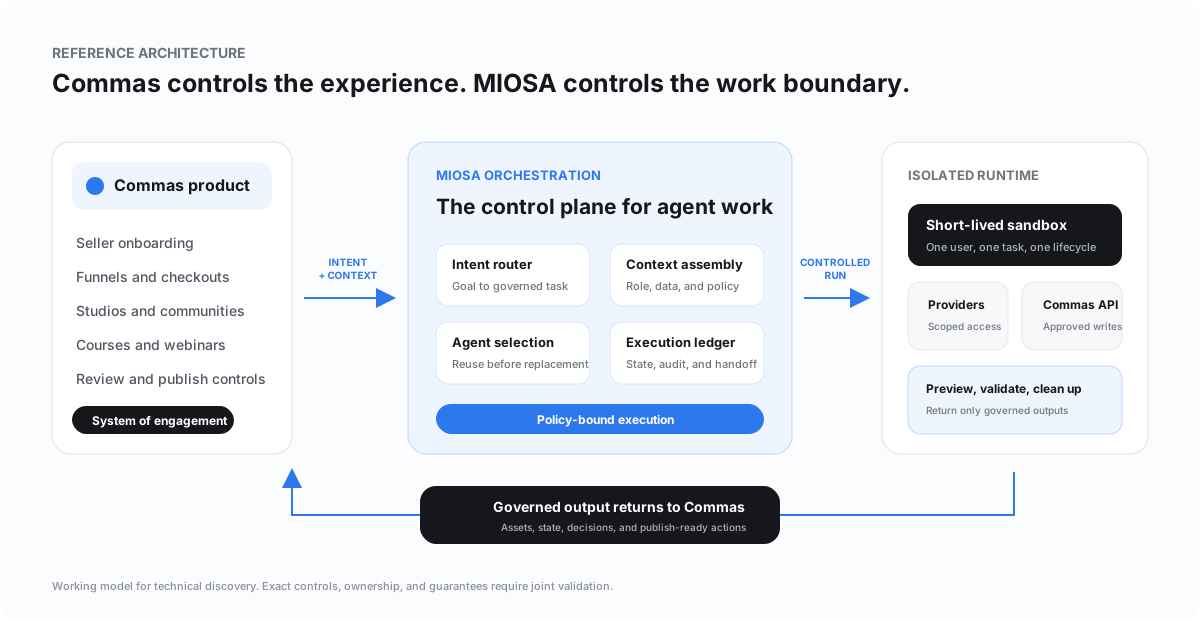
Customer journey, user interface, official product state, tenancy, billing, checkout, publishing, analytics, and customer relationship.
Agent configuration, organizational hierarchy, scoped context, memory, tools, policy, secrets, execution lifecycle, evidence, and decision records.
Approved cloud resources, data stores, network controls, logs, internal services, model providers, and integrations under Commas' authority.
This is a reference boundary, not an assumption about the final implementation. Phase 1 confirms what stays in the current Commas stack, what uses MIOSA interfaces, and what requires a Commas-specific adapter.


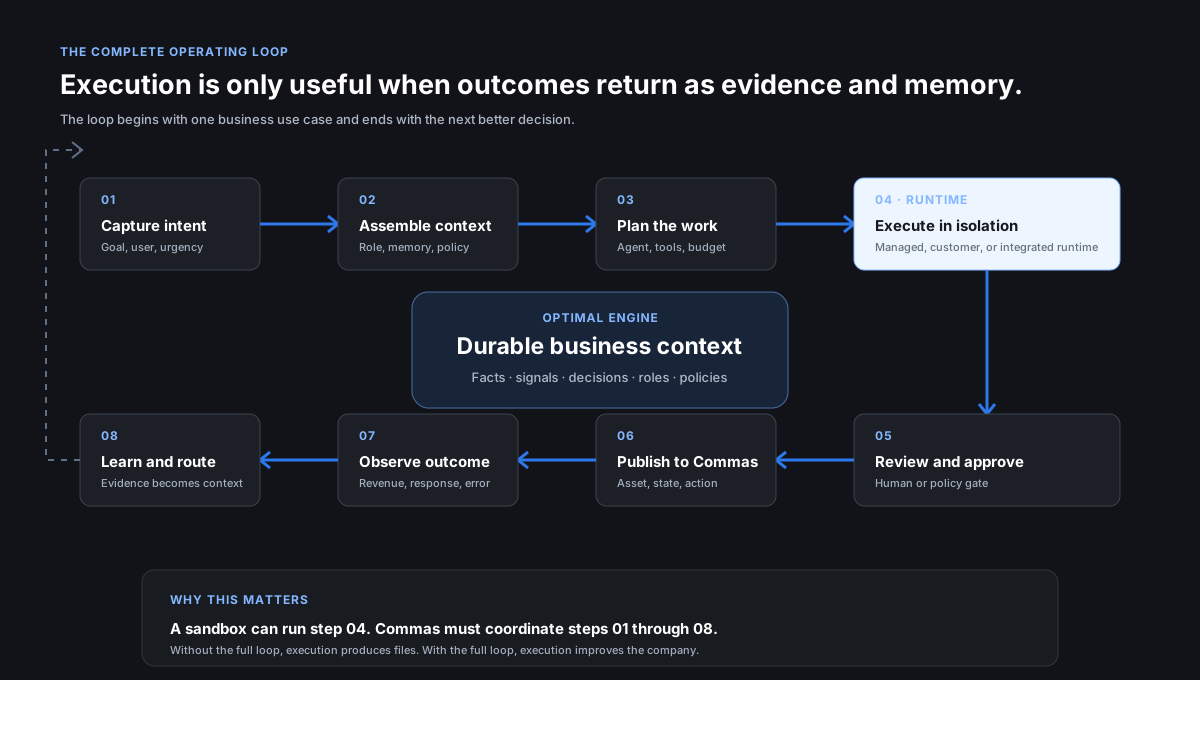
Execution is one step
User, organization, workspace, agent, owner, and delegated authority.
Approved facts, sources, memory, business rules, and customer state.
Tools, budget, credentials, network, review gates, and prohibited actions.
Artifacts, decisions, costs, errors, approvals, outcomes, and the next signal.
The technical objective: let Commas reuse its existing product and agents where appropriate while adding the missing contract around each run. Phase 1 identifies the minimum integration required to close that loop.


Questions that determine the build
Output: a signed decision register that removes ambiguity before implementation begins.


Eight decision-grade deliverables
Relevant code, services, agents, tenancy, APIs, data flows, AWS boundaries, deployment, constraints, and observed failure points.
User profile, starting state, agent interaction, review states, publication event, first proof, baseline, and acceptance criteria.
Application, orchestration, runtime, data, identity, secrets, network, publishing, evidence, and operational boundaries.
Tenant, organization, workspace, user, role, project, agent, policy, memory, and industry-template relationships.
Instructions, models, tools, sources, schemas, credentials, budgets, review gates, prohibited actions, audit, and retention.
Existing Commas capability, MIOSA capability, required adapters, third-party dependencies, owners, and rationale.
Representative scenarios, synthetic evaluation, policy tests, reliability targets, product metrics, operating metrics, and go/no-go gates.
Recommended workstreams, sequence, staffing, dependencies, risks, timing, usage assumptions, and budget ranges.
Deliverables are provided in editable and presentation-ready formats, supported by a final executive, product, and technical readout.


Ten business days after readiness
Kickoff, access, product demo, current architecture, goals, constraints, and readiness.
Selected journey, agent code, APIs, tenancy, data, publishing, checkout, and failure modes.
Architecture, hierarchy, context, agent contract, security, runtime, and ownership.
Team review, threat and failure review, build-vs-integrate decisions, pilot and acceptance.
Final package, implementation options, budget ranges, readout, and next-step decision.
Schedule begins when readiness is confirmed. The clock does not begin while material access, owners, or source information required for the selected journey remain unavailable.


Minimum access, named owners
| Area | Required input | Expected owner |
|---|---|---|
| Executive | Phase 1 objective, decision authority, product priorities, commercial constraints | Yash |
| Product | Current and intended first-dollar journey, existing-business path, beta constraints, success measures | Alisha |
| Application | Relevant repository access, local setup, architecture, current agent implementation, API and SDK references | Bhavin and engineering owner |
| Tenancy | User, team, customer, product, workspace, role, and permission model | Architecture owner |
| Publishing | Current funnel output, domains, deployment, templates, preview, approval, and rollback | Funnel and platform owner |
| Commerce | Checkout SDK, merchant-of-record boundary, billing, cancellation, fulfillment, and event model | Checkout owner |
| Cloud and security | AWS topology, data stores, secrets, network, observability, test tenant, compliance constraints | Cloud and security owner |
| Evidence | Known failures, user feedback, product analytics, representative conversations, current performance | Product and support owners |
A non-production tenant, least-privilege named access, sanitized or representative records, documented approval owners, and a shared decision log.
The mutual NDA governs disclosure. Production credentials, regulated data, or broad repository access are not assumed and require a specific approved method.


A decision asset, not an automatic build commitment
Commas receives five business days to identify material omissions against the agreed deliverables. MIOSA corrects verified omissions without additional professional fees.
New use cases, changed assumptions, implementation requests, or new production requirements are handled through written change control or a later phase.
Commas and MIOSA approve a Phase 2 statement of work for the selected pilot.
Commas uses the decision package and engages MIOSA only where desired.
Commas retains the paid Phase 1 deliverables and may decide not to proceed.
No Phase 2 obligation. The purpose of Phase 1 is to replace assumptions with a decision both teams can defend.


Phase 1 investment
50% due at signature. 50% due upon delivery of the final Phase 1 package.
Approved travel and third-party usage are excluded unless stated in writing.
Begins after signature, initial payment, named owners, and access readiness.
The parties may adjust session dates in writing without changing the scope.
Start sequence: execute the mutual NDA and Professional Services Agreement with Exhibit A, pay the initial invoice, name the decision owners, confirm the selected working environment, and schedule kickoff.
This proposal is a commercial summary. The Professional Services Agreement and its Phase 1 Statement of Work control the engagement if signed.